5 Best Non-Ionic Surfactants for Effective Cleaning Solutions?
In the quest for effective cleaning solutions, "Non-Ionic Surfactants" have emerged as game-changers. Renowned expert Dr. Sarah Mitchell states, "Non-ionic surfactants provide versatility and reduce surface tension, enhancing cleaning efficiency." This quote highlights the importance of these agents in both household and industrial cleaning products.
Non-ionic surfactants are unique. They do not carry a charge, making them compatible with various formulations. This trait allows them to blend well with other ingredients. These surfactants help lift dirt and grease, making cleaning tasks easier. However, the effectiveness of non-ionic surfactants can vary. Factors such as concentration and water hardness can affect their performance.
Choosing the right non-ionic surfactant is crucial. Some may not be suitable for all applications, leading to inefficiencies. Users must consider their specific needs and test different products. Despite their advantages, the industry must continuously improve formulations. The goal is to ensure optimal performance in diverse environments.

Introduction to Non-Ionic Surfactants and Their Importance
Non-ionic surfactants play a vital role in cleaning solutions. They are versatile, effective, and widely used. These surfactants contain no charge, which allows them to work well in various conditions. They can effectively remove dirt, grease, and stains without causing harm to surfaces. This makes them ideal for both household and industrial applications.
Their unique structure makes them suitable for many formulations. They help to lower surface tension, which aids in the spread of cleaning agents. However, not all non-ionic surfactants are created equal. Factors such as temperature and water hardness can affect their performance. For instance, some may perform poorly in hard water. It's essential to choose the right type for the task at hand.
Many users find themselves overwhelmed by choices. Some surfactants fail to deliver the expected results. They may require testing with different concentrations. This experimentation can lead to valuable insights. Even experienced formulators sometimes face challenges. Understanding the importance of non-ionic surfactants is key. Selecting the appropriate one enhances cleaning efficiency significantly.
Characteristics and Properties of Non-Ionic Surfactants
Non-ionic surfactants are popular in cleaning solutions. They have distinct characteristics that make them effective. Unlike ionic surfactants, they do not carry a charge. This property allows them to work well in various conditions. Water hardness doesn’t impact their performance as significantly. Thus, they are versatile in different cleaning scenarios.
These surfactants have a unique ability to reduce surface tension in liquids. This helps in spreading the cleaning solution evenly across surfaces. They can emulsify oils and dirt effectively. However, not all non-ionic surfactants perform equally well in every situation. One may encounter issues with certain formulas not achieving the desired results. Adjusting concentration levels can sometimes lead to better outcomes.
The hydrophilic and hydrophobic balance of non-ionic surfactants can vary. This balance is crucial for their function. If misjudged, it can result in a solution that underperforms. It's essential to test different combinations before settling on a formula. Keeping an open mind is vital, as what works for one application might fail in another. Exploring various options will enhance the cleaning process significantly.
Top 5 Non-Ionic Surfactants for Cleaning Applications
Non-ionic surfactants play a crucial role in cleaning applications. These compounds are valued for their mildness and effectiveness. They do not carry a charge, which allows them to work well in a variety of conditions. By 2027, the global market for non-ionic surfactants is projected to reach approximately $20 billion, showcasing their growing importance in various industries.
One of the best applications of non-ionic surfactants is in formulating cleaning solutions. They enhance the ability to remove dirt and grease without harsh effects on surfaces. A study by the American Cleaning Institute highlighted that using non-ionic formulations could increase cleaning efficiency by up to 35%. This is particularly relevant for household cleaners and industrial applications.
When selecting non-ionic surfactants, consider your specific needs. Not all types will work equally well for all surfaces. A tip: conduct small-scale tests before full application. Also, be open to adjusting concentrations based on what you observe. Cleaning products should be effective yet safe for both users and surfaces. Understanding the environmental impact is also essential. Balancing cleaning power with sustainability can be challenging, but it is necessary for effective cleaning solutions.
Comparative Analysis of Non-Ionic Surfactants and Other Types
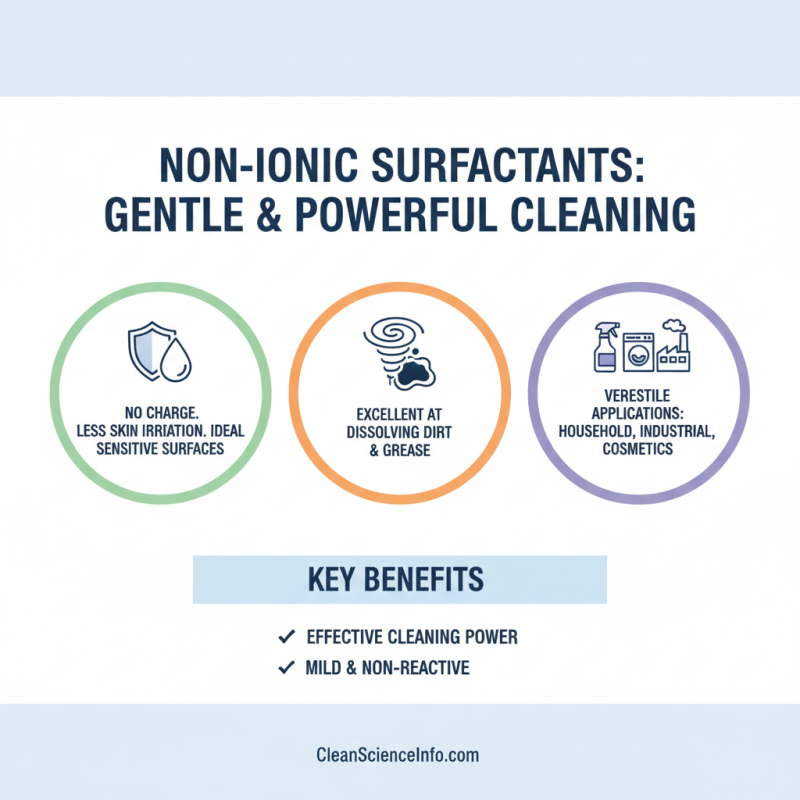
Non-ionic surfactants have unique characteristics that set them apart from ionic surfactants. They do not carry a charge, making them less likely to irritate skin. This property is essential for cleaning products designed for sensitive surfaces. Non-ionic surfactants excel in dissolving dirt and grease. Their effectiveness is seen in various applications, from household cleaners to industrial detergents.
However, when comparing non-ionic surfactants to anionic and cationic types, there are some limitations. Non-ionic surfactants may require higher concentrations for similar performance. This can lead to cost concerns in large-scale production. They also tend to be less effective in hard water conditions. Anionic surfactants can perform better when it comes to foaming and soil removal in such environments.
It's important to consider the environmental impact as well. Non-ionic surfactants often biodegrade more easily than their ionic counterparts. But this does not make them entirely eco-friendly. The production processes can still pose challenges. Reflecting on these nuances helps us choose the right surfactants for our cleaning needs. Balancing effectiveness, safety, and environmental considerations is crucial in our cleaning solutions.
Practical Applications of Non-Ionic Surfactants in Cleaning Solutions
Non-ionic surfactants are versatile agents in cleaning solutions. Their ability to reduce surface tension makes them effective in various applications. Reports indicate that these surfactants work well in both hard and soft water, enhancing cleaning performance. They can disperse oils and dirt, making them indispensable in many formulations.
In industrial settings, non-ionic surfactants are commonly utilized in detergents and formulations for textile processing. Their mildness allows for use in sensitive applications, like cleaning delicate fabrics without causing damage. Studies show that the right concentration can significantly improve cleaning efficiency, achieving results without harsh chemicals.
**Tip:** Always measure surfactant concentrations accurately. Too much can lead to residues, while too little may not clean effectively.
In household cleaning products, non-ionic surfactants help remove grease and stains. Users often notice they work better in colder temperatures compared to ionic surfactants. However, understanding the formulation balance is crucial. The wrong mix can result in reduced efficacy or unwanted effects, such as skin irritation.
**Tip:** Consider testing different concentrations. This helps find the optimal level for your specific cleaning tasks.
While non-ionic surfactants offer numerous benefits, they aren't a perfect solution. Their effectiveness can vary significantly depending on water quality and dirt type. Regular evaluation of product performance is essential for optimal cleaning outcomes.
5 Best Non-Ionic Surfactants for Effective Cleaning Solutions
| Surfactant Name |
CAS Number |
Applications |
Advantages |
| Octylphenol Ethoxylate |
9036-19-5 |
Household cleaners, detergents |
Effective in hard water, excellent wetting properties |
| Nonylphenol Ethoxylate |
9016-45-9 |
Industrial cleaning applications |
Low toxicity, great emulsification properties |
| Sorbitan Fatty Acid Esters |
67784-80-9 |
Food and cosmetic products |
Biodegradable, versatile applications |
| Cocamidopropyl Betaine |
61789-40-0 |
Shampoos, body washes |
Mild surfactant, enhances foam |
| Decyl Glucoside |
68890-66-4 |
Personal care products, cleaning agents |
Plant-derived, gentle on skin |