2026 Best Non-Ionic Surfactant Options for Global Buyers?
In today's rapidly evolving market, choosing the right Non-Ionic Surfactant is crucial for various industries. These surfactants offer excellent stability and versatility, making them a popular choice among global buyers. They play a vital role in formulations, enhancing the effectiveness of products like detergents and cosmetics.
Understanding the unique properties of different Non-Ionic Surfactants can be a challenge. Buyers often face a vast array of options, each with its own advantages and limitations. Evaluating these products requires expertise and experience in the field. Knowledgeable professionals must navigate the complexities of formulation compatibility and environmental impact.
As industries shift towards sustainable practices, the demand for eco-friendly Non-Ionic Surfactants is on the rise. This trend prompts a reevaluation of traditional products. Buyers need to consider not just performance but also sustainability and safety. The landscape is changing, and staying informed is essential.

Overview of Non-Ionic Surfactants and Their Applications
Non-ionic surfactants play a crucial role in various industries. They are widely used in household cleaners, personal care, agriculture, and industrial applications. Their unique properties enable them to reduce surface tension effectively, allowing for better wetting and spreading. These surfactants do not carry an electrical charge, making them versatile in different environments. The versatility of non-ionic surfactants often leads to their preference in formulations where pH stability is essential.
These surfactants find applications in emulsifying agents and detergents, contributing to product effectiveness. For example, many formulations benefit from their ability to stabilize emulsions, enhancing texture and consistency. In agriculture, they help in the efficient delivery of pesticides and fertilizers. However, selecting the right non-ionic surfactant requires careful consideration. Different formulations have varied requirements, which can affect performance.
While non-ionic surfactants are effective, some challenges remain. Their performance can fluctuate based on environmental conditions, such as temperature and salinity. Manufacturers must test their products rigorously. This approach ensures consistent outcomes. Understanding application contexts can elevate formulation success. The exploration of non-ionic surfactant options continues to evolve, pushing boundaries in sustainability and efficiency.
Key Characteristics of Non-Ionic Surfactants in Diverse Industries
Non-ionic surfactants are vital across many sectors, including personal care, agriculture, and cleaning products. Their ability to enhance solubility and emulsification makes them invaluable. According to industry reports, the demand for non-ionic surfactants is projected to grow by 4.3% annually until 2026. These surfactants are favored for their minimal irritation potential and efficiency in different pH environments.
One key characteristic of non-ionic surfactants is their versatility. They function effectively in various temperatures and conditions. In personal care, they provide excellent foam stability and are mild on the skin. In agriculture, they help improve pesticide efficacy, which is crucial for sustainable farming practices. However, the environmental impact of surfactants is still an area of concern. Striking a balance between efficacy and safety is essential.
Tip: When selecting a non-ionic surfactant, assess the application requirements. Be aware of compatibility issues, especially in formulations with ionic surfactants. Consider conducting small-scale tests to gauge effectiveness and stability. Remember, the right selection can significantly enhance product performance.
2026 Best Non-Ionic Surfactants Characteristics
This chart illustrates key characteristics of non-ionic surfactants that are essential in various industries, including detergency, emulsification, wetability, foam stability, and biodegradability. Understanding these characteristics can help global buyers make informed decisions about non-ionic surfactants in their applications.
Top 2026 Non-Ionic Surfactant Brands and Their Unique Features
When considering non-ionic surfactants, several brands stand out in 2026. These surfactants are known for their mildness and effectiveness. Their unique properties cater to various applications, from detergents to emulsifiers. Many brands focus on sustainability, utilizing renewable resources in their formulations.
One notable feature of these surfactants is their ability to perform well in hard water. They maintain stability in diverse conditions, making them versatile. Some brands offer biodegradable options, which align with growing environmental concerns. It's essential to evaluate their performance based on specific needs. Not all non-ionic surfactants deliver the same results, and formulation adjustments may be necessary.
However, not every choice is perfect. Some users have reported that certain non-ionic surfactants do not mix well with other ingredients. This can lead to unexpected reactions. It's crucial for buyers to conduct thorough testing before full-scale applications. Reflecting on your experiences with various brands can provide valuable insights.
2026 Best Non-Ionic Surfactant Options for Global Buyers
| Feature |
Value |
| Type |
Non-Ionic |
| Common Applications |
Household Cleaners, Personal Care Products, Agricultural Formulations |
| Key Benefits |
Low skin irritation, Effective in hard water, Good detergency |
| Environmental Impact |
Biodegradable, Low toxicity |
| Formulations |
Liquid, Powder, Granules |
| Market Trends |
Increased demand for eco-friendly products, Innovations in formulations |
| Global Reach |
Asia-Pacific, North America, Europe |
| Cost Range |
$1.50 - $15.00 per kg |
Comparative Analysis of Pricing for Non-Ionic Surfactants Globally
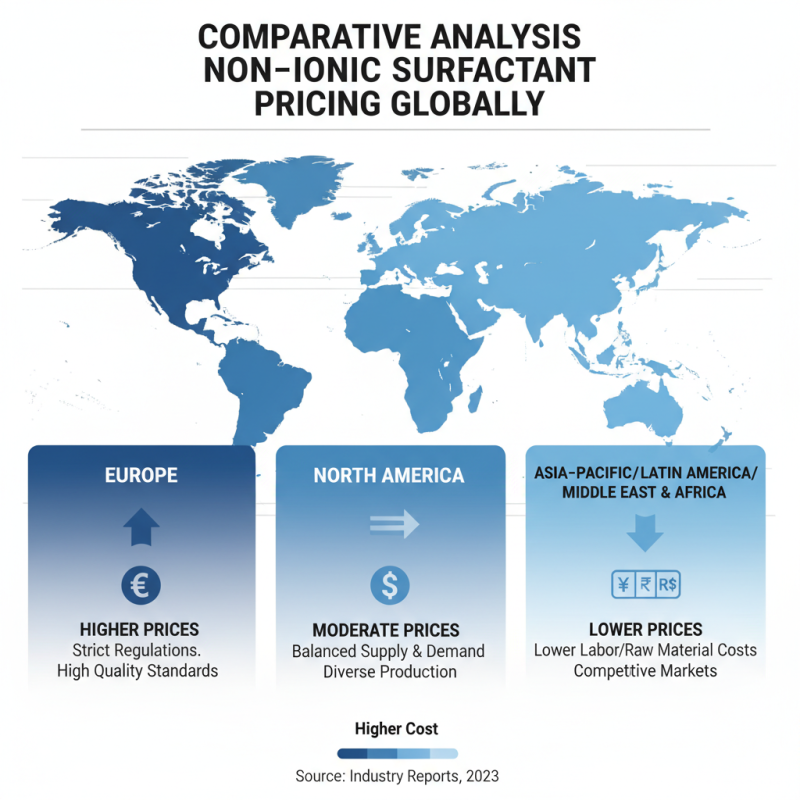
The global market for non-ionic surfactants has been evolving rapidly. Pricing varies significantly across regions, reflecting different production costs and local demand. In Europe, for instance, prices tend to be higher due to stricter regulations and higher quality standards. In contrast, some developing regions may offer more competitive pricing, influenced by lower labor and raw material costs.
When comparing options, it’s important to consider not just the price, but also the quality and application suitability. Some surfactants may have lower upfront costs but could lead to higher expenses in the long run due to inefficiency or poor performance. Engaging with suppliers who offer technical expertise can help in making informed choices. Buyers often overlook the importance of these consultations, focusing solely on purchase price.
Additionally, regional economic conditions play a critical role in pricing fluctuations. Political stability and trade agreements can impact costs significantly. Regular market assessments are essential for buyers to navigate these changes effectively. Ignoring these dynamics could result in missed opportunities or increased operational costs. Understanding the interplay between pricing, quality, and market factors is key for making optimal purchasing decisions.
Environmental Impact and Sustainability of Non-Ionic Surfactants
Non-ionic surfactants are becoming increasingly important in the context of environmental sustainability. These agents offer numerous benefits without the drawbacks often associated with ionic surfactants. They are less likely to contribute to water pollution and can be biodegradable under the right conditions. Many users appreciate this aspect, as they can be used safely in various applications, including household products and industrial processes.
However, the production and use of non-ionic surfactants still pose challenges. The sourcing of renewable raw materials is crucial. Many surfactants rely on petrochemicals, which can negate their eco-friendly properties. It’s essential to evaluate the carbon footprint of these compounds during their life cycle. Not all non-ionic surfactants are created equal; some may not meet the sustainability benchmarks set by environmental agencies.
Companies and consumers alike are urged to scrutinize product labels and research their options. The balance between effectiveness and sustainability remains a grey area. Users should reflect on the impact of their choices, considering whether their preferred surfactant truly aligns with their environmental values. Finding the best option requires commitment to continuous improvement and awareness of emerging alternatives.