How to Choose the Right Non-Ionic Surfactant for Your Formulation Needs
In the realm of formulation science, selecting the right ingredients can greatly impact the efficacy and stability of products. Among these ingredients, Non-Ionic Surfactants play a crucial role due to their versatility and mildness, making them suitable for a wide range of applications from personal care to industrial cleaning. According to a report by MarketsandMarkets, the market for non-ionic surfactants is projected to grow significantly, with a compound annual growth rate (CAGR) of 4.5% from 2021 to 2026, reflecting the increasing demand for environmentally friendly and effective surfactants.
Industry expert Dr. Emily Carter emphasizes the importance of precisely selecting Non-Ionic Surfactants in formulation. She states, "The right surfactant can enhance the performance of a product while minimizing skin irritation and environmental impact." This underscores the reality that while formulating with Non-Ionic Surfactants, consideration must be given to the molecular structure and functional characteristics to achieve the desired balance between foaming, wetting, and emulsifying properties.
As formulators navigate the complexities of ingredient compatibility and performance, understanding the specific needs of their applications remains essential. Thus, the focus on Non-Ionic Surfactants is not only justified by their unique properties but also by the growing consumer awareness and regulatory pressures favoring safer, more sustainable formulations.

Understanding Non-Ionic Surfactants: Definition and Benefits
Non-ionic surfactants are a unique class of surface-active agents characterized by the absence of electric charge on their hydrophilic head groups. This property enables them to interact with both polar and non-polar substances, making them versatile components in various formulations. They play a crucial role in several applications, including detergents, emulsifiers, and wetting agents, due to their ability to reduce surface tension at liquid interfaces. As a result, non-ionic surfactants are particularly effective in stabilizing emulsions and enhancing solubility, making them a preferred choice in industries ranging from cosmetics to agriculture.
One of the primary benefits of non-ionic surfactants is their milder nature compared to ionic surfactants. They are less likely to cause skin irritation, making them suitable for personal care products. Furthermore, their compatibility with a wide range of chemicals allows formulators to create effective and stable products without the challenges associated with the use of ionic surfactants, such as precipitation in the presence of electrolytes. Moreover, non-ionic surfactants exhibit excellent performance across various pH levels and temperatures, offering flexibility and reliability in formulation design. These characteristics make them an essential consideration for formulators seeking to optimize the effectiveness and safety of their products.
Comparison of Non-Ionic Surfactants in Formulations
Identifying Your Formulation Requirements and Goals
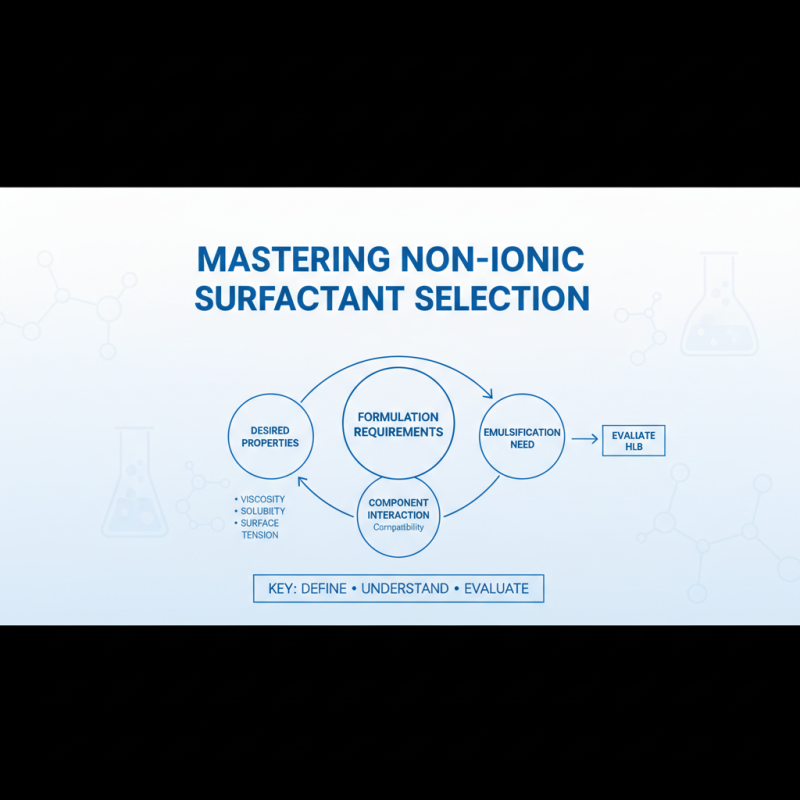
Identifying your formulation requirements and goals is a critical step in selecting an appropriate non-ionic surfactant. First, it’s essential to define the properties you need from your formulation. Consider factors such as viscosity, solubility, and surface tension, which will influence the performance of the surfactant in your specific application. Understanding the interaction between the surfactant and other formulation components can also guide you in making informed decisions. For instance, if your formulation requires emulsification, you must evaluate the hydrophilic-lipophilic balance (HLB) of potential surfactants to ensure compatibility and effectiveness.
In addition to the physical and chemical properties, it’s important to contemplate the intended use and target market of your formulation. For instance, products designed for sensitive skin may call for mild, non-irritating surfactants, while industrial applications might prioritize foaming or wetting properties. Assessing environmental factors and regulatory compliance is also crucial, especially when considering sustainable formulations. By aligning the surfactant’s characteristics with your formulation goals, you can enhance performance, achieve stability, and meet product expectations, ultimately leading to a successful end product.
Evaluating the Properties of Different Non-Ionic Surfactants
When evaluating the properties of different non-ionic surfactants for formulation needs, it is essential to begin with understanding their fundamental characteristics. Non-ionic surfactants are characterized by their lack of charge, which allows them to interact with a broad range of substances without the risk of precipitation or instability in various formulations.
Key properties to consider include hydrophilic-lipophilic balance (HLB), cloud point, and solubility in various solvents. The HLB value assists formulators in determining the emulsifying or wetting capability of a surfactant, as different applications may require specific balance levels for optimal performance.
Another critical factor is the surfactant’s thermal and oxidative stability, particularly in formulations that may be subject to varying conditions over time. The cloud point indicates the temperature at which a non-ionic surfactant transitions from a clear solution to a cloudy state, which can impact its performance in different environmental conditions. Additionally, the formulation's intended application, whether in cosmetics, pharmaceuticals, or cleaning products, will dictate specific requirements regarding viscosity and compatibility with other ingredients.
By carefully assessing these properties, formulators can select the most suitable non-ionic surfactant tailored to their specific formulation needs, ensuring effectiveness and stability throughout the product's lifecycle.
Testing and Optimizing Surfactant Compatibility in Formulations
When formulating products with non-ionic surfactants, ensuring compatibility with other components is crucial for achieving desired performance. Testing surfactant compatibility involves a systematic approach where various surfactants are mixed with the formulation ingredients under controlled conditions. By observing physical and chemical properties such as viscosity, stability, and any phase separation, formulators can identify which surfactants integrate smoothly without compromising the overall efficacy of the product.
Optimizing surfactant compatibility also requires an understanding of how different factors, including temperature, pH, and ionic strength, influence the interaction between surfactants and other formulation components. Conducting compatibility tests over a range of these variables can reveal the most effective conditions for incorporating the chosen surfactant. Additionally, performing draw-down tests, where small samples of the formulation are created and analyzed, can provide insights into the real-world performance of the formulation, leading to adjustments that enhance stability and usability. By carefully evaluating these aspects, formulators can confidently select a non-ionic surfactant that meets their specific formulation needs.
How to Choose the Right Non-Ionic Surfactant for Your Formulation Needs
| Surfactant Name |
HLB Value |
Solubility in Water |
Recommended Applications |
Temperature Stability |
| Alkyl Polyglucoside |
10-16 |
Excellent |
Household cleaners, Personal care |
Up to 60°C |
| Sorbitan Monolaurate |
8.6 |
Limited |
Emulsions, Food industry |
Up to 100°C |
| Polysorbate 20 |
16.7 |
Excellent |
Food, Cosmetics |
Up to 70°C |
| Cocamidopropyl Betaine |
30 |
Good |
Shampoos, Cleansers |
Up to 95°C |
| Decyl Glucoside |
12 |
Excellent |
Foaming agents, Personal Care |
Up to 60°C |
Cost Considerations and Sourcing Options for Non-Ionic Surfactants
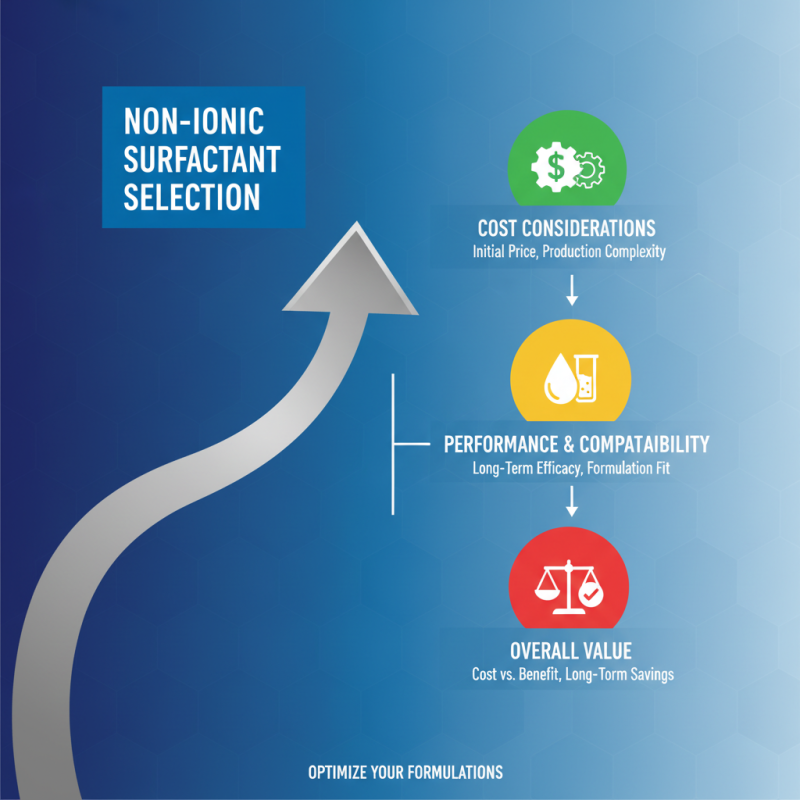
When selecting a non-ionic surfactant for your formulation needs, cost considerations play a critical role. Non-ionic surfactants can vary significantly in price based on their source and the complexities of their production processes. It's important to factor in not only the initial purchase price but also the long-term costs associated with performance and compatibility within your formulations.
One key tip for cost-effectiveness is considering bulk purchasing options. Many suppliers offer discounts for larger quantities, which can reduce the unit price significantly. Moreover, building a good relationship with suppliers can lead to better deals and access to new products before they hit the market. Always evaluate the performance versus cost relationship to ensure that the chosen surfactant meets your formulation goals without compromising quality.
Sourcing options should also align with your sustainability goals. Many manufacturers are now producing non-ionic surfactants from renewable resources, which might come at a premium price but can provide better marketability and compliance with green chemistry practices. Exploring local suppliers can reduce shipping costs and lead times, thus contributing to overall efficiency and cost savings while supporting local economies.