Top Benefits of Non-Ionic Surfactants for Global Buyers?
Non-Ionic Surfactants are essential in various industries, ranging from agriculture to cleaning products. Their unique properties offer significant advantages for global buyers. These surfactants differ from ionic types by having no charge, which enhances their compatibility with different formulations.
In the agricultural sector, Non-Ionic Surfactants help improve pesticide efficiency. These agents enhance the spreading and adhesion of chemicals on plant surfaces. This can lead to better absorption and, ultimately, improved crop yield. Their versatility also extends to household cleaning products, where they provide effective dirt removal.
Despite these benefits, some challenges arise. Non-Ionic Surfactants can be sensitive to environmental factors. Their performance may vary based on formulation and usage conditions. Buyers must evaluate these aspects to ensure optimal results. Understanding this complexity can help in making informed purchasing decisions.

Overview of Non-Ionic Surfactants and Their Properties
Non-ionic surfactants have unique properties that set them apart from other surfactants. They are versatile, providing effective performance in various applications, including cleaning, emulsifying, and foaming. Unlike ionic surfactants, non-ionics are less sensitive to pH changes and the presence of electrolytes, making them stable in diverse environments. This quality is crucial for global buyers seeking consistency in product performance.
These surfactants have excellent wetting and spreading abilities. They can penetrate surfaces quickly, enhancing cleaning efficiency. Non-ionic surfactants are widely used in household and industrial cleaners. They provide effective soil removal while being gentle on surfaces. This balance between power and gentleness is appealing to many consumers and manufacturers alike.
However, there are challenges in using non-ionic surfactants. Their performance can vary based on formulation and environmental conditions. Buyers must consider these factors to maximize effectiveness. Understanding the specific properties of each non-ionic surfactant is essential. This knowledge allows for better product development and application strategies. A thoughtful approach can lead to improved efficacy and customer satisfaction.
Key Applications of Non-Ionic Surfactants in Various Industries
Non-ionic surfactants play a vital role across various industries. Their versatile properties make them ideal for a wide range of applications. These surfactants are known for their ability to emulsify and solubilize, making them valuable in formulations for personal care, household products, and industrial cleaning. In the cosmetics industry, non-ionic surfactants help stabilize emulsions, enhancing the texture and efficacy of lotions and creams.
In agriculture, non-ionic surfactants serve as adjuvants. They improve the spreading and wetting of pesticides on plant surfaces. This increases the effectiveness of treatments, leading to better crop yields. In the textile industry, they are used in dyeing processes. They ensure uniform color distribution and prevent fabric damage. Such benefits highlight their crucial role in enhancing product performance.
However, the use of non-ionic surfactants raises questions. Their environmental impact is a concern that requires attention. Biodegradability should be a priority in formulation development. Innovations in creating eco-friendly non-ionic surfactants must continue. Balancing performance with sustainability is essential for future advancements in the industry.
Top Benefits of Non-Ionic Surfactants for Global Buyers - Key Applications of Non-Ionic Surfactants in Various Industries
| Industry |
Key Applications |
Benefits |
| Household Cleaning |
Surface cleaners, detergents |
Effective dirt removal, low foam |
| Personal Care |
Shampoos, lotions |
Gentle on skin, enhances texture |
| Agriculture |
Pesticide formulations |
Improved wetting, better efficacy |
| Food Industry |
Emulsifiers, stabilizers |
Enhanced flavor, improved shelf life |
| Textiles |
Dyeing, finishing agents |
Better dye uptake, soft feel |
| Pharmaceuticals |
Formulations, delivery systems |
Improved solubility, stability |
Advantages of Non-Ionic Surfactants Over Ionic Surfactants
Non-ionic surfactants offer distinct advantages over their ionic counterparts. These surfactants do not carry a charge, which allows them to be effective in various pH levels. This characteristic lends them versatility in applications such as detergents and cosmetics. Their stability in hard water enhances their performance, making them reliable choices for global buyers.
One key advantage of non-ionic surfactants is their compatibility with other ingredients. They blend well with cationic and anionic substances. This feature simplifies formulations and improves effectiveness. Users may find that products formulated with non-ionic surfactants deliver better performance in emulsification and wetting.
Tips: When selecting surfactants, consider the required application. Non-ionic surfactants are ideal for sensitive formulations. Assess the environmental impact as well. Sustainable options are increasingly available in this segment. By paying attention to sourcing, buyers can make responsible choices that align with their values.
Environmental Impact and Sustainability of Non-Ionic Surfactants
Non-ionic surfactants are gaining attention due to their environmental impact. Unlike ionic surfactants, non-ionic surfactants do not carry a charge. This property makes them less toxic to aquatic life. They decompose more readily in nature, reducing long-term pollution. Reports indicate they are 50% less toxic than anionic surfactants. In industries relying on green chemistry, these surfactants fit perfectly.
A notable benefit is their stability across various pH levels and temperatures. This versatility enhances their application in formulations ranging from household cleaners to personal care products. Enhanced formulation flexibility is crucial, as sustainable practices are now a priority. It pushes manufacturers to explore greener alternatives.
Tip: When choosing surfactants, always verify their biodegradability. Look for certifications confirming environmental safety.
The industry faces challenges, though. The efficiency of non-ionic surfactants in hard water can be variable. Users often report mixing issues, particularly in household products. Ongoing research aims to address these gaps. It allows for better formulations that remain effective and environmentally friendly.
Tip: Experiment with formulations to find the right balance. Adjust surfactant ratios to optimize performance while remaining eco-conscious.
Guidelines for Selecting Non-Ionic Surfactants for Buyers
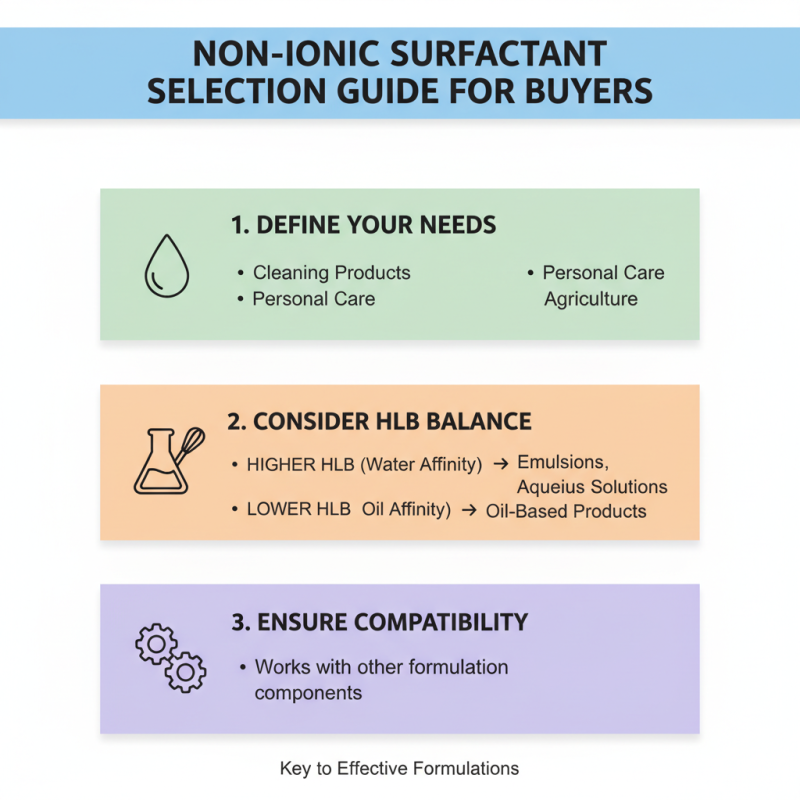
When selecting non-ionic surfactants, understanding your specific needs is crucial. Non-ionic surfactants are versatile and effective in various applications, such as cleaning, personal care, and agricultural products. Buyers should consider the surfactant's hydrophilic-lipophilic balance (HLB) to ensure compatibility with other components in the formulation. A higher HLB means greater water affinity, ideal for forms like emulsions. In contrast, a lower HLB works better for oil-based products.
It's important to assess the purity and stability of these surfactants. Impurities can greatly affect performance and safety. Always review technical data sheets for information on these aspects before making a purchase. Additionally, engage with manufacturers to gather insights into their production methods. This not only builds trust but also ensures they adhere to quality standards. Reliability in supplier communication is essential for long-term success. However, not every supplier will meet expectations every time, so be prepared to adapt your strategy if issues arise.